Stefan Neis
Head of Projects Mobility
2026-2029
A functioning cross-border hydrogen ecosystem for companies: that is the goal of the Interreg project EMR H2-HUBs. It aims to help drive forward the development of hydrogen infrastructure in the Meuse-Rhine Euroregion and establish hydrogen as an energy carrier. EMR H2-HUBs runs for three years.
This is because hydrogen is considered a crucial component to a clean energy supply, helping companies to operate more independently and in a more climate-neutral manner. The project primarily advises and connects small and medium-sized companies to facilitate their transition to hydrogen. To this end, hydrogen hubs are being created in the partner regions – jointly developed by companies, research institutions and politicians.
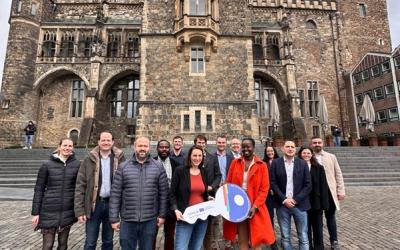
The cooperation of ten project partners makes it possible to pool and utilise different skills and experiences. In Germany, the participants are the City of Aachen, the Aachen City Region, the Düren District Administration, the Chamber of Industry and Commerce (IHK) Aachen, the Economic Development Agency for the District of Heinsberg and the Structural and Economic Development Department of the District of Euskirchen. In Belgium, the cluster TWEED, Green Energy Park and GRE-Liège are providing support. The partner in the Netherlands is WaterstofNet.
EMR H2-HUBs is being implemented as part of the Interreg Maas-Rhine (NL-BE-DE) programme and co-financed by the European Union (approx. €1,174,475), the state of North Rhine-Westphalia (€428,301), Wallonia (€190,512) and the Dutch Ministry of Economic Affairs (EZK) (€33,144). By investing EU funds in Interreg projects, the European Union is investing directly in economic development, innovation, territorial development, social inclusion and education in the Meuse-Rhine Euroregion.
Consult the H2-HUBs folder for the general public and the folder for companies.
Role of WaterstofNet
WaterstofNet represents NL-Limburg, South-East Brabant, and Flanders and is the work package (WP) 5 leader. In WP 5, WaterstofNet will:
Naturally, WaterstofNet is involved in all work packages and acts as the link with local parties in its region to inform companies about the transition to hydrogen.