
12 November 2026
‘EU Investment Booster’ design and operation conditions discussed in stakeholder consultation event
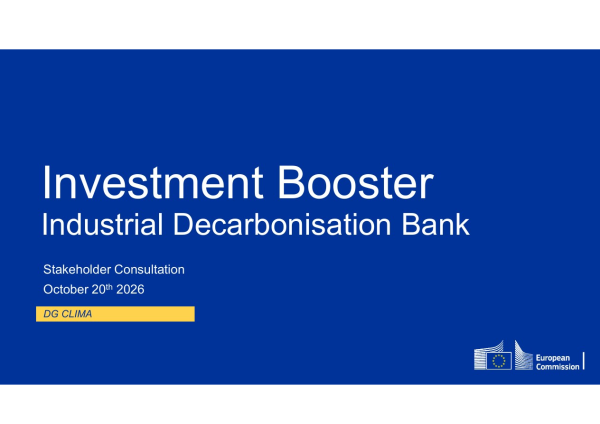
At the start of the EU H2 week, DG Clima organized a stakeholder event on the ‘Investment Booster’, the first stage of the Industrial Decarbonsation bank which was announced within the context of the Clean Industrial Deal. Unlike the Innovation Fund's competitive auctions, the Booster would operate (in a first phase between 2027-2030) on a first-in, first-served basis, supporting mature, investment-ready projects through a fixed premium per tonne of CO₂ emissions avoided. This approach particularly favours hydrogen projects with advanced permitting, secured infrastructure access and a credible business case, while more innovative, first-of-a-kind technologies would remain primarily within the Innovation Fund.
Hydrogen is identified as one of three main decarbonisation pathways, alongside electrification and carbon capture and storage (CCS). According to the proposed eligibility mapping in Annex A (pages 15–17 of the discussion paper), hydrogen production through electrolysis would qualify if it meets RFNBO or electrolytic low-carbon hydrogen criteria, opening support to renewable as well as qualifying low-carbon electricity-based hydrogen. Blue hydrogen produced through steam methane reforming with CCS is also being considered, while blue hydrogen produced by autothermal reforming and CCS would not be eligible. Blue ammonia production using CCS is explicitly included, alongside renewable and electrolytic low-carbon ammonia, methanol and synthetic aviation and maritime fuels.
On the demand side, eligible applications include hydrogen-based steel production (DRI), hydrogen feedstock use in chemicals and high-temperature industrial heating above 400°C, while hydrogen for medium-temperature heat is excluded. The final eligible technologies, specific conditions and differentiated carbon premiums still need to be defined in the Terms & Conditions expected in 2027. A public consultation will be launched one of the coming weeks.
More info, including the discussion paper and the presentation used at the stakeholder event, can be found through this link.