
Green light for standardised hydrogen swappable containers for inland shipping
RH2INE Receives ‘Approval in Principle’ from Lloyd’s Register
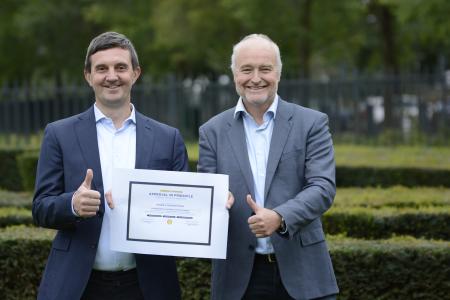
RH2INE (Rhine Hydrogen Integration Network of Excellence) has officially obtained an ‘Approval in Principle’ (AiP) from Lloyd’s Register for the standardised design of hydrogen swappable containers. As a result, interchangeable containers designed according to the open standard can now be deployed more easily for zero-emission hydrogen-powered inland shipping throughout the Rhine corridor. This official milestone marks the transition from theoretical frameworks to a practical, deployable mobile hydrogen infrastructure for inland cargo vessels, push barges and other waterborne transport.
Over the past year, RH2INE’s standardisation working group collaborated intensively to develop an open, safe and certified standard for interchangeable 380-bar hydrogen containers in both 20-foot and 40-foot formats. The group consisted of thematic experts, industrial RH2INE partners (Air Products, Air Liquide, NPROXX, Hexagon Purus, H2Storage, ArgoAnleg, RheinMetall, Covess, ZBT,…) together with maritime certification body Lloyd’s Register. In close consultation with EIGA (European Industrial Gases Association), they defined, among other things, the connections, safety components and coupling systems for hydrogen swappable containers (Multiple-Element Gas Container, or MEGC tank containers).
The concept of hydrogen swappable containers has been well known within RH2INE and the wider sector for some time. The official design approval demonstrates that the concept is technically feasible before the start of detailed engineering. Companies can now confidently design and build according to the approved concept.
Multimodal
A key advantage of the developed concept is its multimodal versatility and future interoperability. The containers not only serve as interchangeable onboard fuel tanks, but are also certified for hydrogen storage and transport by road, rail and inland waterway (in accordance with ADR, RID and ADN regulations, respectively). This enables the entire logistics chain and industrial end users to deploy the container as a standardised asset, maximising the return on investment.
Removing uncertainty
"With this Approval in Principle, we demonstrate that zero-emission hydrogen-powered inland shipping is no longer a distant vision, but a safe, standardised and practically achievable reality within reach. By enabling the container to function both as a vessel fuel tank and as a transport container, we remove uncertainty for shipowners and investors," emphasises Diederick Luijten, Manager at RH2INE. "With the active support of 13 public authorities - including ports, provinces and national governments - within the RH2INE network, we can now roll out this development," adds Tom Verlinden, RH2INE Programme Manager.
Decarbonisation
With more than 13,000 commercial inland vessels, European inland shipping is estimated to account for approximately 5.5 to 6 megatonnes (Mt) of CO₂ emissions per year. The majority of these emissions occur in the Netherlands and Germany, Europe’s two largest inland shipping markets. Although inland shipping has a significantly lower carbon footprint per tonne-kilometre than road transport, the sector also faces the urgent challenge of decarbonising at scale to meet climate targets.
Complementary solutions
Hydrogen is highly complementary to battery-electric solutions in inland shipping. While batteries are ideally suited for shorter routes, hydrogen provides the range and power required for heavy-duty, long-distance voyages along the Rhine. Both technologies are fully zero-emission. Furthermore, the flexible storage of renewable energy in hydrogen containers plays a key role in balancing electricity grids in the Netherlands, Belgium and Germany. This makes the chosen container solution both strategically and technically well aligned with future energy needs.
Next steps towards clean shipping
With the approved design basis now in place, the RH2INE consortium is focusing on three concrete follow-up actions. "First, we will launch pilot projects by deploying the developed containers as mobile hydrogen infrastructure on hydrogen-powered vessels. Next, we will establish green shipping corridors by creating zero-emission routes throughout the Rhine Delta - initially through point-to-point connections and later through a comprehensive network. Finally, we will scale up the market by gradually expanding the fleet (with more vessels and containers) while stimulating the production and uptake of green hydrogen," concludes Diederick Luijten. At the same time, investors will establish the Rh2ineTainer Company (RTC), which will manage and lease these hydrogen swappable containers to inland shipping operators.
For the time being, the RH2INE open standard for hydrogen swappable containers for inland shipping can be requested and consulted by email via the email addresses below.
Contact:
Diederick.Luijten.extern@waterstofnet.eu +31 6 54733591
Tom.Verlinden@waterstofnet.eu +32 472 322710
The participating RH2INE partners:
DOWNLOAD THE PRESS RELEASE:
In English
In Dutch
In German
About RH2INE
RH2INE (Rhine Hydrogen Integration Network of Excellence) is a cross-border initiative dedicated to accelerating the deployment of hydrogen in inland shipping. Its core ambition is to develop a market-ready hydrogen ecosystem along the Rhine and its tributaries, enabling zero-emission waterborne transport.
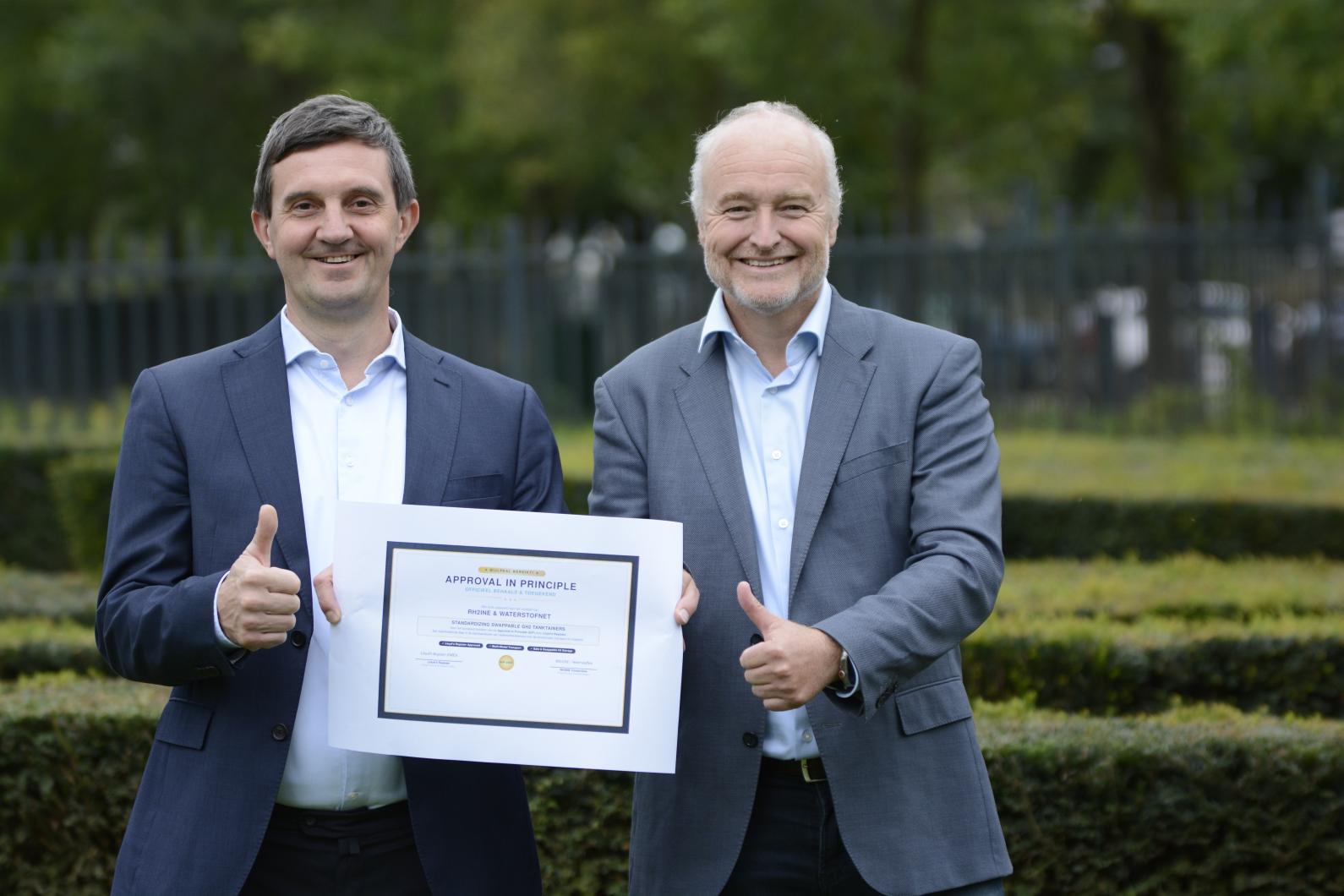
Tom Verlinden and Diederick Luijten with the Approval in Principle.